


Everything you need to know
Two-day trip details
To see current prices for each rate (adults, children, students and infants), select your preferred date in the booking calendar. The price shown in the calendar is always the final price.
Check the available days and times directly in the booking calendar: it updates in real time according to the season.
There are three pick-up points in central Seville. The one you choose is also where the trip ends.
C. Trajano 6, Casco Antiguo, 41001 Seville · View on Google Maps
C. Zaragoza 1, Casco Antiguo, 41001 Seville · View on Google Maps
C. Rastro 12A, 41003 Seville · View on Google Maps
Not every pick-up point is available on every date: the booking calendar shows which ones you can choose and the exact time. We recommend arriving with time to spare.
This trip crosses an international border, so a valid passport is compulsory. A national ID card is not enough.
You must provide the full name and passport number of every traveler at the time of booking.
Bring the passport itself. Without it you cannot board the ferry, enter Morocco or check into the hotel.
Most visitors do not need a visa: citizens of the European Union, the United Kingdom, the United States, Canada, Australia, New Zealand, Japan and most Latin American countries can enter for up to 90 days without one. If you want to be certain, the official Moroccan government portal tells you in one step what your nationality needs.
Round-trip transport from Seville and return ferry tickets between Tarifa and Tangier.
One night in a 4 star hotel in Tangier.
A local Moroccan guide and a guided tour of the surroundings and the historic centre.
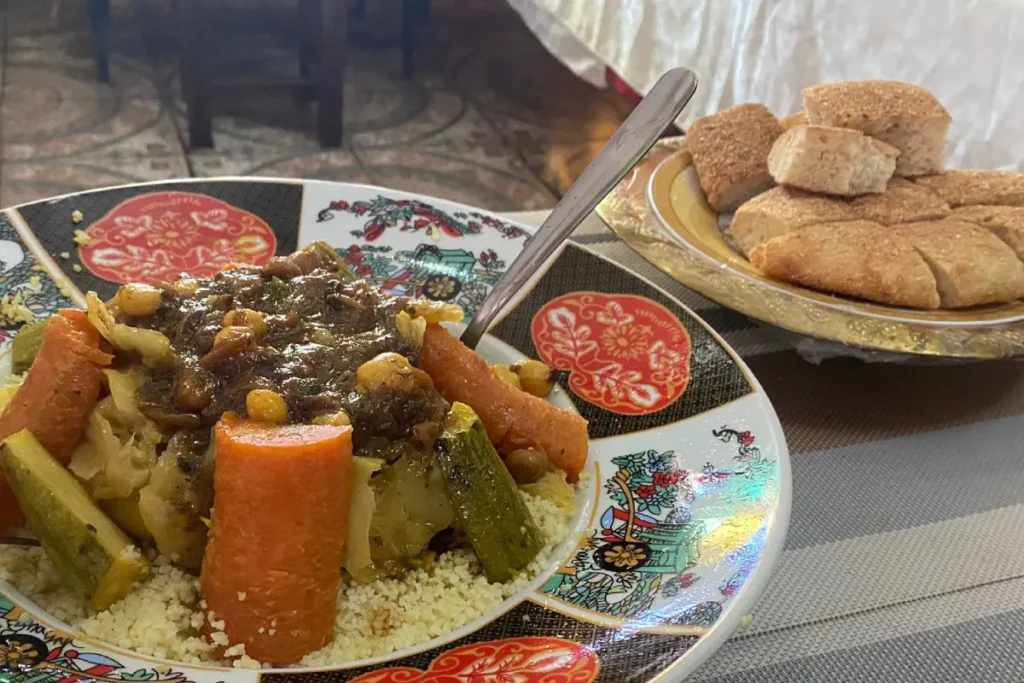
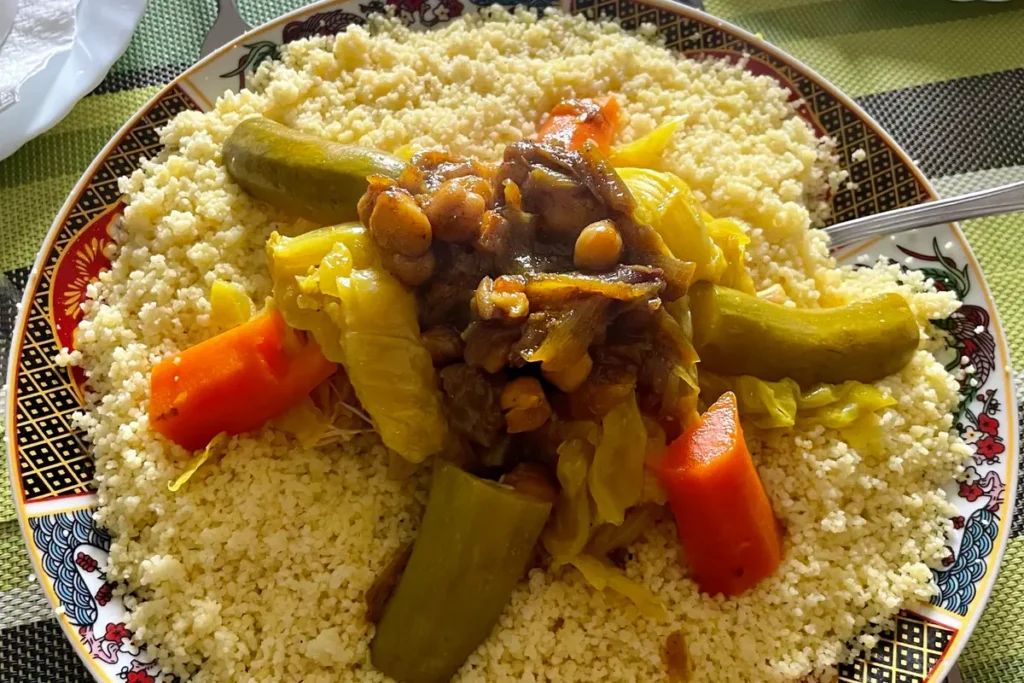
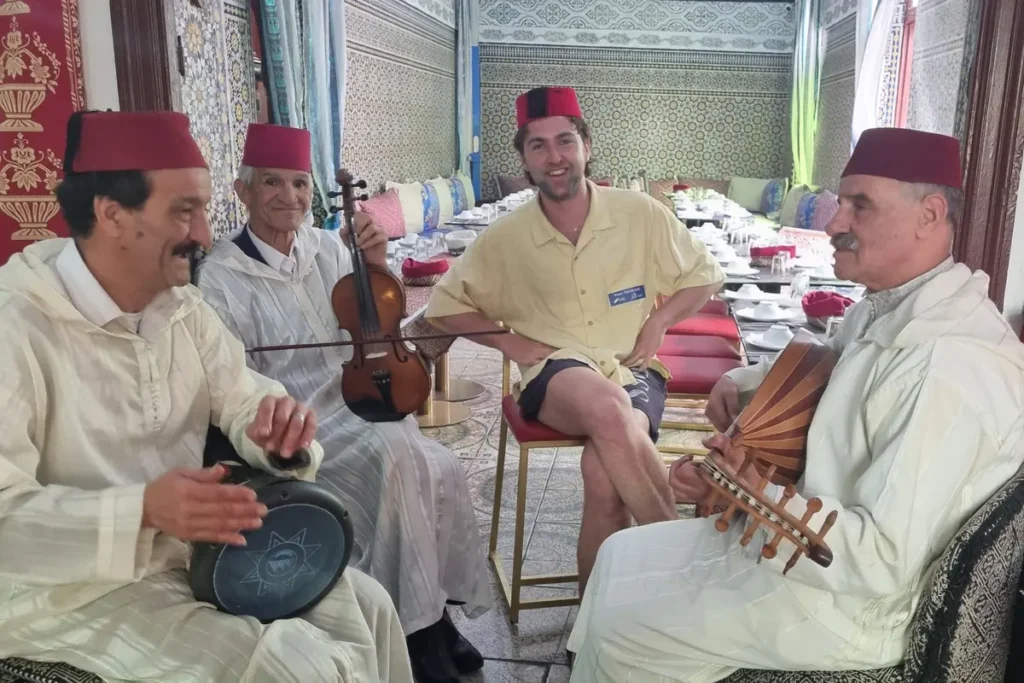
One traditional Moroccan lunch on the first day, drinks excluded, and breakfast on the second.
Dinner, other meals and drinks are not included.
The order of the visits may change depending on the group, the sailing times or the time of year.
Your passport, above everything else. Check the night before that you have it.
Pack light: one night means one small bag, and the medina is walked on foot.
Comfortable footwear. The old town is visited on foot over uneven streets and slopes.
The local currency is the dirham and it cannot be bought outside Morocco. Small purchases in tourist areas are often accepted in euros, though at a poor rate.
Modest dress draws less attention in the old town: shoulders and knees covered is a good rule.
Free cancellation up to 24 hours before the activity. You can cancel from the confirmation email you receive when you book.
One exception: if you arrive without your passport or without the documentation needed to enter Morocco, the booking cannot be refunded.
The best-rated guide to Seville
First-hand local advice, more than 90 pages in PDF: what to see, where to eat, museums and palaces, day trips, opening hours and prices, and tourist maps of the city. Book any activity with us and it’s yours. Get the guide
 Eduardo BallesterosSeville local and author of the guide
The two-day trip
Africa, with time to stay for the evening
The day trip to Tangier gets you across the Strait and back before midnight, and it is a long day. This one gives you the same crossing, the same guided city, and then the part the day trip never sees: Tangier after the ferries have gone.
Across the Strait
The morning goes south to the port of Tarifa, the southernmost point of mainland Europe, and across to Africa on the fast ferry in about an hour. A local Moroccan guide meets the group on the other side.
The city, and lunch
The guided tour takes in the surroundings of Tangier and then the historic centre on foot, through the medina and the streets around it. A traditional Moroccan lunch is included on this first day, in a local restaurant.
The evening, which is the point
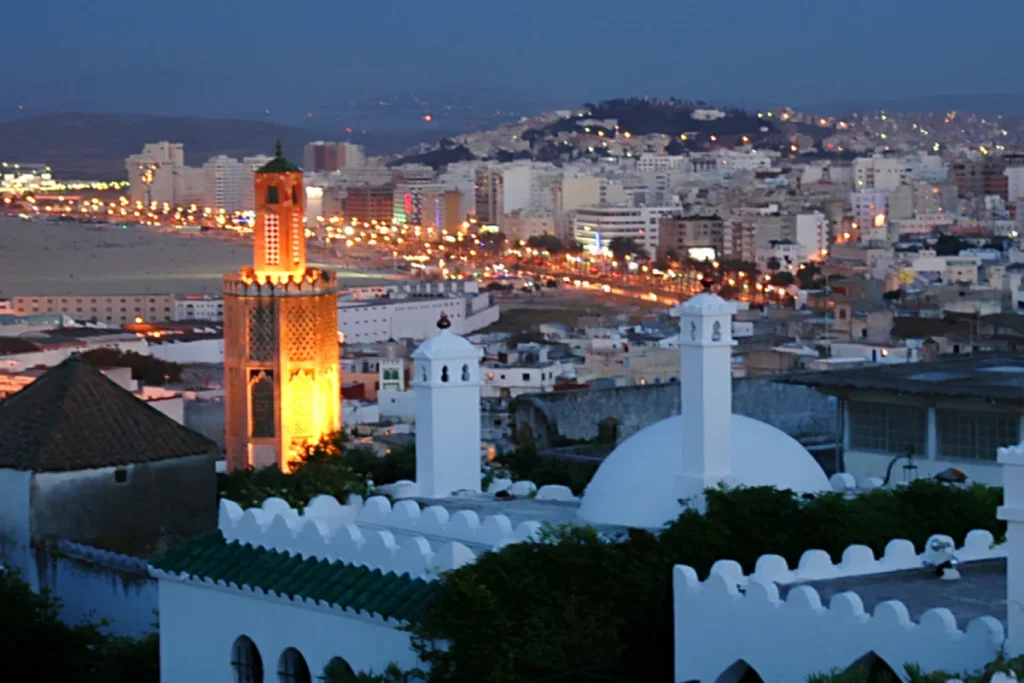
By late afternoon the day-trippers are queuing for the ferry and you are checking into a hotel. Tangier in the evening is a different city: the corniche fills, the cafes along the Boulevard do most of their business, and the light off the Strait at dusk is the reason painters kept coming here.
Day two and the crossing back
After breakfast at the hotel the group heads back to the port for the ferry to Tarifa and the drive to Seville. Everything beyond breakfast on the second day is yours to arrange, which in practice means one more walk through the medina before you go.
Important: the order and format of the route may vary depending on the time of year, the weather, road conditions and each town’s local holidays. Your guide will organize the trip in whatever way works best for the group.
Your questions answered
Frequently asked questions
Yes, and there is no way around it. Tangier is in Morocco, so this is an international border crossing and a national ID card is not accepted. You also have to give the full name and passport number of every traveler when you book, and the hotel requires the document at check-in.
You will not be able to board the ferry, and the booking cannot be refunded. It is the one exception to the free cancellation policy.
Yes. One night in a 4 star hotel in Tangier is included, along with breakfast the following morning. Rooms are allocated by the operator; if you want one to yourself a single supplement applies.
Two: the traditional Moroccan lunch on the first day, without drinks, and breakfast at the hotel on the second. Dinner and everything else are at your own expense.
The day trip is about fifteen hours door to door and gets you back to Seville the same night. This one does the same crossing and the same guided city but leaves you in Tangier for the evening and the following morning, which is when the place stops being a day-trip destination.
No. After breakfast the group returns to the port for the ferry. The guided programme is on the first day.
Yes, in both directions, along with the road transport from Seville to Tarifa and back.
Spanish, English, French and Italian. You choose when you book. French and Italian need a minimum of three travelers to be guaranteed; if that number is not reached, it runs in English or Spanish.
From central Seville. There are three pick-up points and the booking calendar shows which ones are available on your date. The pick-up point is also the drop-off point.
It depends on the bookings for each date, and groups are usually small. In high season the group is split into two or more subgroups: as a rule, groups are no larger than 30 people.
A fair amount on the first day. The historic centre of Tangier is visited entirely on foot, over uneven streets and slopes, so comfortable shoes make a real difference.
Yes, and there is a reduced rate for children. Splitting the crossing over two days is considerably easier on younger travelers than the fifteen-hour version. Children need their own passport.
We would not recommend it. The trip involves a ferry crossing, several changes of vehicle and a walking tour over uneven ground.
Yes. Cancellation is free up to 24 hours before the activity.
Planning your stay in Tangier
Practical questions about the city, useful background before you travel.
It is enough to see it and not enough to feel it. A day gives you the Caves of Hercules, the coast and a walk through the medina, all of it in the busiest hours. A night adds the evening, which is when the corniche fills and the city belongs to the people who live in it.
The walled citadel at the top of the medina, where the sultans had their palace. The Dar el Makhzen inside it is now a museum, and the small square in front of it, the Place de la Kasbah, looks out over the Strait to Spain. It is the highest and quietest part of the old town.
Compact by Moroccan standards and easier to navigate than Fez or Marrakesh, which is part of why Tangier works as a first visit. It slopes down from the Kasbah to the port through narrow lanes, with the Grand Socco and the Petit Socco as its two main squares.
Because for thirty odd years it was not really governed by anybody. From 1923 to 1956 Tangier was an International Zone administered jointly by several powers, with almost no restrictions and very low costs. Paul and Jane Bowles, William Burroughs, Truman Capote and the Beat writers all passed through, and Matisse painted here decades earlier.
The headland northwest of the city where the Atlantic meets the Mediterranean, marked by a lighthouse built in 1864 by an international consortium. The Caves of Hercules sit just below it, and the view from the point takes in both seas at once.
For the medina, yes. Cards work in hotels and larger restaurants, but the souk, the small cafes and the taxis run on dirhams. You cannot buy them before you travel, so you change money or use an ATM once you arrive.
The central areas are busy and well lit into the late evening and are generally regarded as safe. The usual big-city sense applies: stick to the main streets and the corniche, keep valuables out of sight, and be aware that unofficial guides may approach you near the medina gates.
Fish, because it is a port. Grilled sardines and fried whitebait at the market stalls, tagines with preserved lemon, and harira soup. Mint tea is poured from a height everywhere and is not optional, and the pastries in the Petit Socco are worth the walk.