

Everything you need to know
Half-day trip details
To see current prices for each rate (adults, children, students and infants), select your preferred date in the booking calendar. The price shown in the calendar is always the final price.
Check the available days and times directly in the booking calendar: it updates in real time according to the season.
You are picked up at your hotel or accommodation in central Seville, and dropped off there at the end. If the vehicle cannot reach your address, the pick-up is at the nearest accessible point.
Pick-up at your accommodation is only available if you are staying in central Seville. If you are staying outside it, choose C. Rastro 12A, 41003 Seville as your pick-up point when you book and make your own way there. · View on Google Maps
Once you have booked, the exact time and pick-up point are confirmed with you by email or telephone. We recommend being ready a few minutes early.
Round-trip transport from Seville in a private vehicle, and a professional guide.
A guided tour of the winery and its facilities, led on site by one of the winery team.
A tasting of the wines produced there.
Food and drink beyond the tasting are not included. This is a half-day activity and there is no meal stop.
Flat, closed shoes. Cellar floors are often wet and uneven.
Cellars are kept cool and dim all year round, so a light layer is worth having even in August.
Have something to eat beforehand. The tasting is a real one and it comes before lunch.
Strong perfume or aftershave interferes with everyone else’s tasting, including your own. Worth leaving off.
It is a four-hour activity, so you are back in Seville with most of the day still ahead of you.
Free cancellation up to 24 hours before the activity. You can cancel from the confirmation email you receive when you book.
Ways to visit
Choose how you visit
Everything on this page describes the shared half-day trip. The same visit is also sold in other formats, each with its own group size, languages and price, and every one of them is booked right here.
Shared half-day trip
From €95per adult
- GroupRegular group
- LanguagesEN / ES / FR / IT, chosen when you book
The same four hours as this page describes, in a regular group, with transport from Seville, the tour of the winery and the tasting.
Check datesPrivate group
From €377per group
- GroupYour party only
- LanguagesEN / ES / FR / IT, chosen when you book
The same morning for your party alone, priced per group rather than per person, with pick-up at your accommodation in Seville.

The best-rated guide to Seville
First-hand local advice, more than 90 pages in PDF: what to see, where to eat, museums and palaces, day trips, opening hours and prices, and tourist maps of the city. Book any activity with us and it’s yours. Get the guide
 Eduardo BallesterosSeville local and author of the guide
The half-day trip
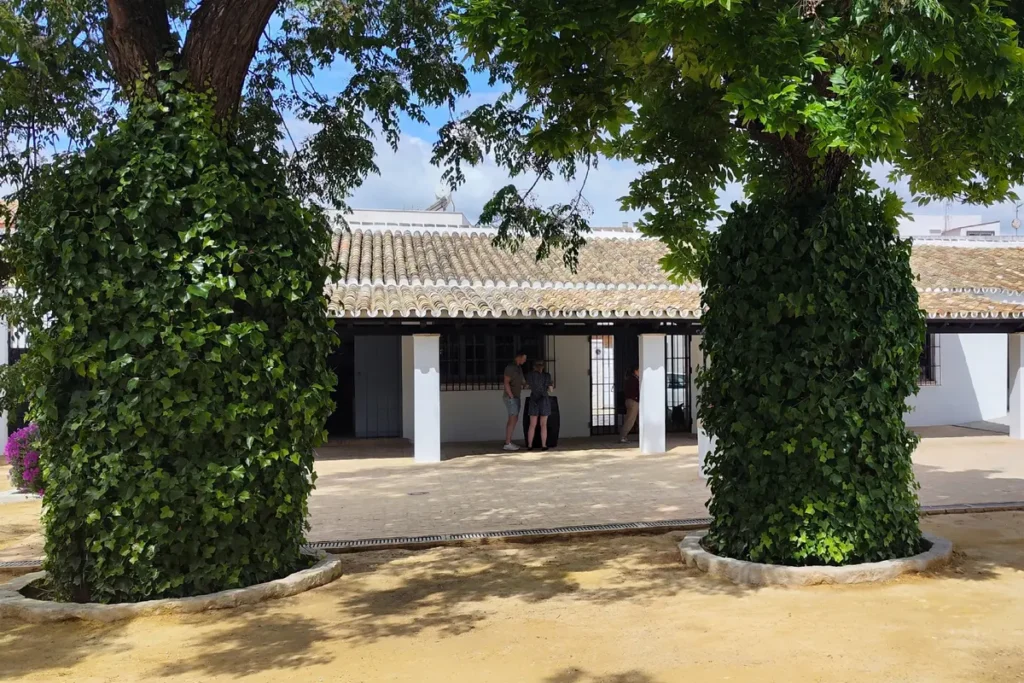
A working cellar in the Seville countryside
Andalusia is far better known for sherry, but the countryside around Seville has been making wine since the Romans, and it was from this port that Spanish wine first crossed the Atlantic. This half day goes out to a traditional winery to see how it is made and to taste what comes out.
Out of the city
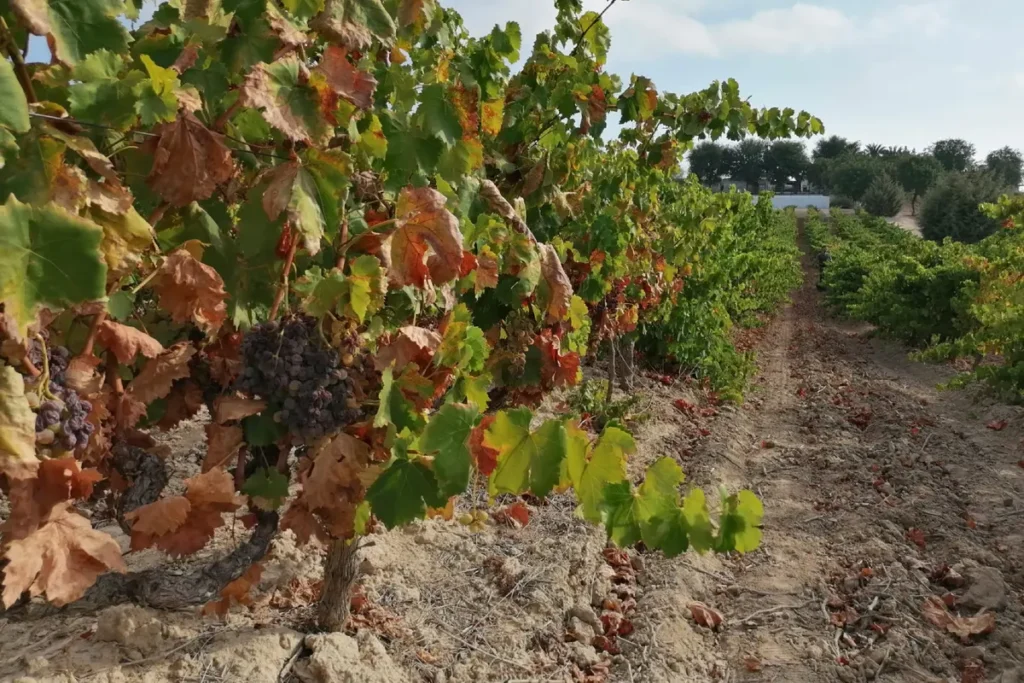
A private vehicle takes the group out of Seville into the surrounding countryside, past vineyards and olive groves, to one of the old wineries that still work here. It is a short drive, which is what makes this a half day rather than a full one.
How the wine is made
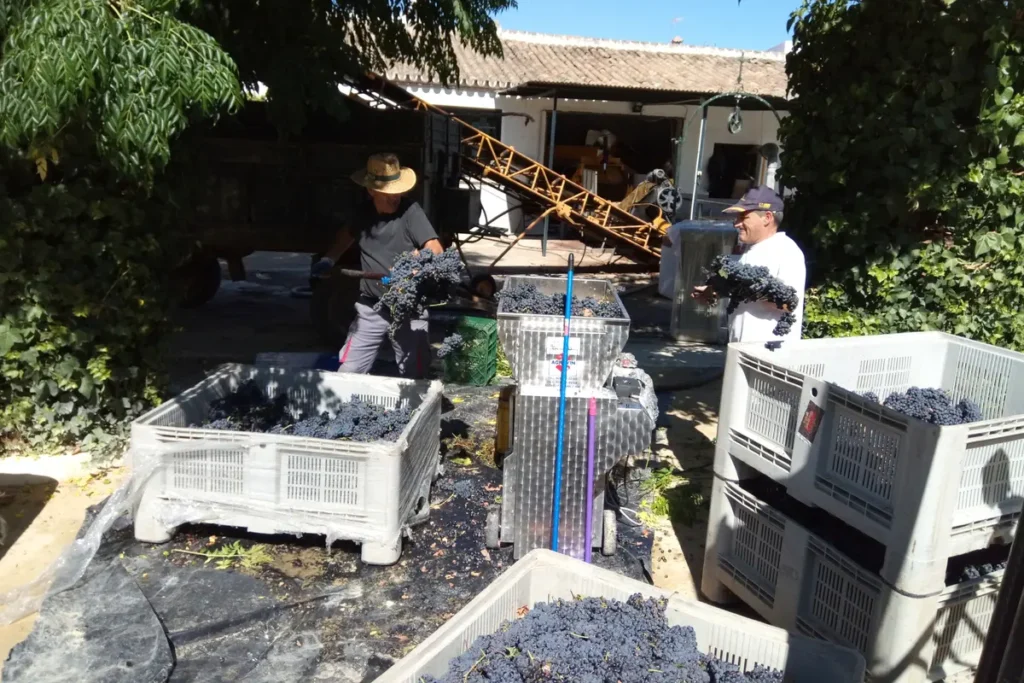
Someone from the winery itself shows you round, which is the difference between a tour and a tour. You follow the grape from the vineyard through pressing, fermentation and ageing, and see the vessels the wine sits in, from stainless steel to old wooden casks.
The ageing cellar
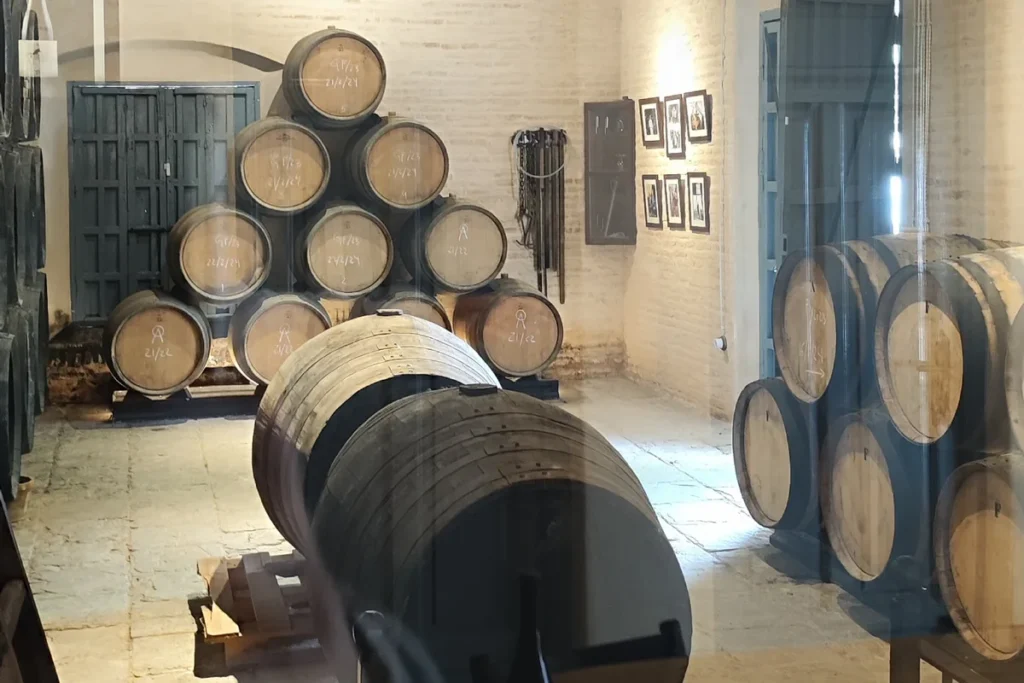
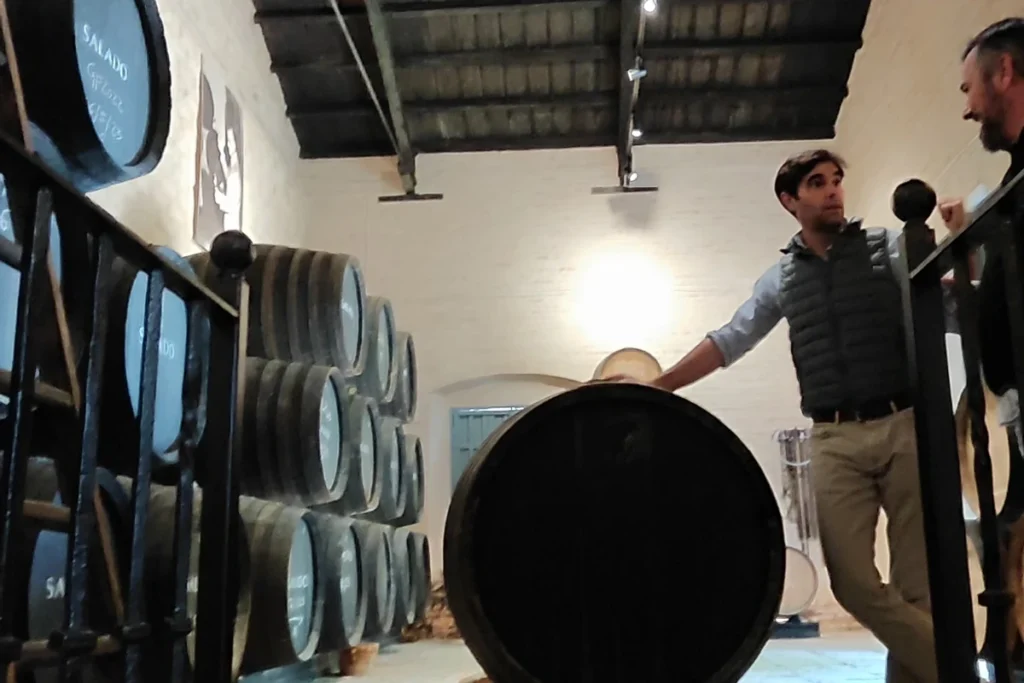
The cellar is the part people photograph: rows of barrels in the half-dark, held at a steady temperature, where the wine spends its months or years. It is also where the guide explains why Andalusian winemaking looks different from the north, and what the heat does to a grape.
The tasting
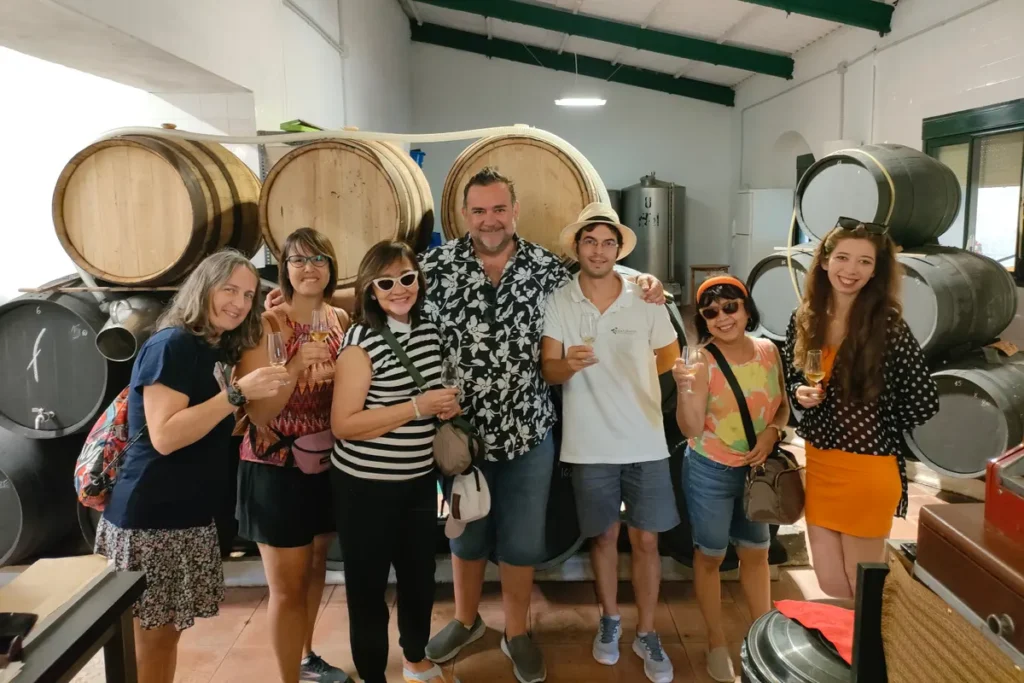
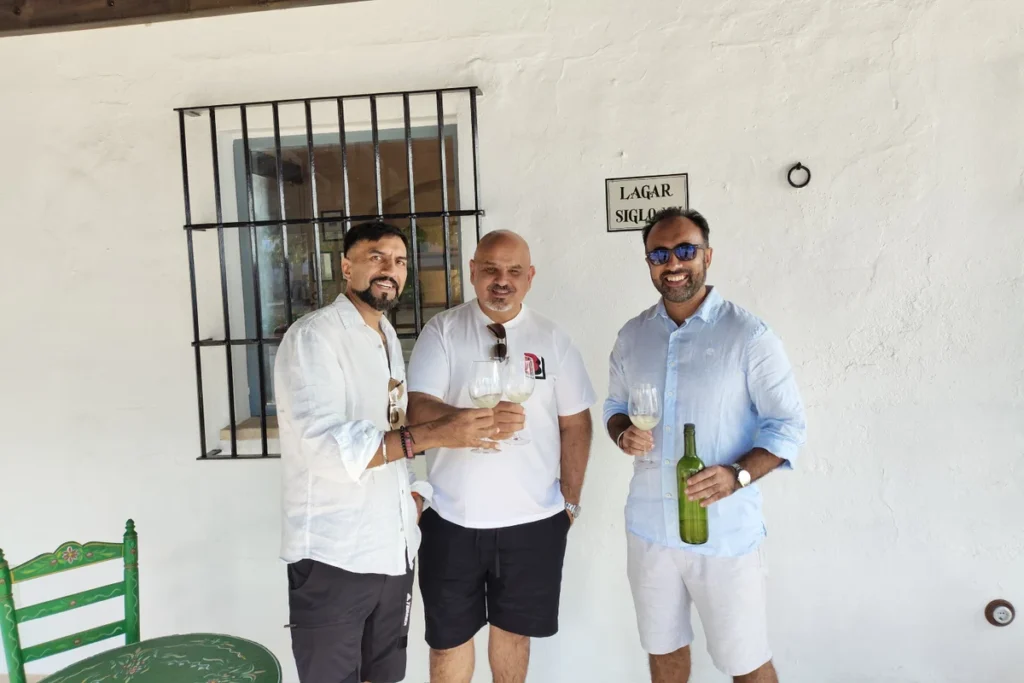
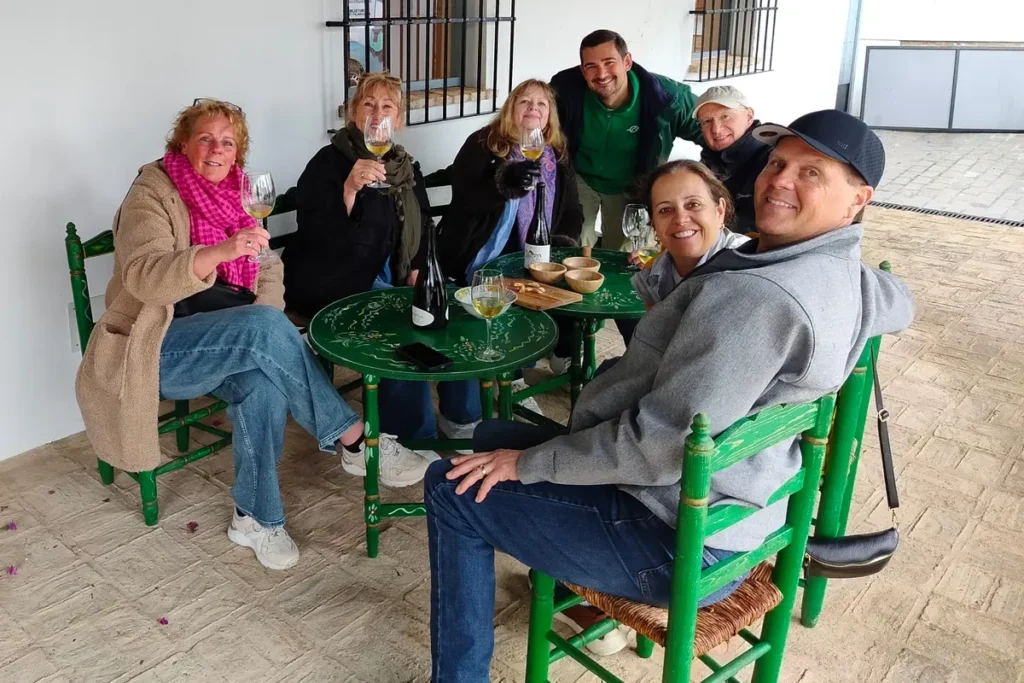
The visit closes with a tasting of the wines made on site, with time to ask questions and to talk about what you are drinking. Most visitors arrive expecting sherry and leave surprised by what the province of Seville actually produces.
Important: the order and format of the route may vary depending on the time of year, the weather, road conditions and each town’s local holidays. Your guide will organize the trip in whatever way works best for the group.
Your questions answered
Frequently asked questions
Around four hours in total, including the drive each way. It is a half-day activity, so you are back in Seville with the rest of the day free.
Yes. The guided tour of the winery and the tasting of its wines are both included in the price.
Enough to show the range the winery makes. The exact selection is theirs and varies with what is in bottle, which is normal at a working cellar rather than a tasting room.
You are welcome on the visit all the same. The cellar tour stands on its own and nobody is expected to drink.
No. That one is a full day, goes to a sherry bodega in Jerez de la Frontera and combines it with the city of Cadiz. This is a half day at a winery in the province of Seville, making table wine rather than sherry.
Spanish, English, French and Italian. You choose when you book. Usually the guide runs the day in one language, although it is sometimes run in two at once, with the guide alternating between them.
You are picked up at your hotel or accommodation in central Seville, and that is also where the trip ends. After you book, the exact time and pick-up point are confirmed with you by email or telephone. If you are staying outside central Seville, choose C. Rastro 12A as your pick-up point instead and make your own way there.
Yes, round trip. You travel in a comfortable, air-conditioned vehicle, van, minibus or coach, depending on how many travelers have booked for that date. Some have a toilet on board; if yours does not, you can ask your guide to stop at a service area.
It depends on the bookings for each date, and groups are usually small. In high season the group is split into two or more subgroups: as a rule, groups are no larger than 30 people. If you would rather not share the vehicle with anyone, you can book it as a private group.
No, and there is no meal stop. Beyond the tasting itself, food and drink are not included.
Yes, and there is a reduced rate for children and students. They join the tour of the facilities but of course not the tasting.
Partly. Cellars are usually on the level but the floors are uneven and often wet, and parts of the estate are walked on unpaved ground.
Yes. Cancellation is free up to 24 hours before the activity.
Planning your winery visit
Practical questions about Andalusian wine, useful background before you travel.
Yes, and it has for two thousand years, although it is overshadowed by its neighbours. The Aljarafe, the ridge west of the city, was covered in vineyards for centuries, and Lebrija in the south of the province holds its own denomination of origin. It is a small production compared with Jerez, which is part of why few visitors know about it.
Sherry is a fortified wine, made only in the triangle around Jerez, aged under a veil of yeast or with deliberate exposure to air, and blended through the solera system. Wine made around Seville is table wine: fermented, aged and bottled by vintage, like wine anywhere else.
Because everything bound for the Americas left from here. For most of the sixteenth and seventeenth centuries Seville held the monopoly on trade with the Indies, and wine was among the largest cargoes. The vines planted across Latin America began as cuttings shipped out of this port.
Palomino dominates in sherry country and Pedro Ximenez in Montilla-Moriles, both white. Around Seville you also find Garrido Fino and Zalema, and increasingly international varieties like Syrah, Tempranillo and Cabernet, which cope with the heat.
Look, swirl, smell, then taste a small amount and let it move across the whole mouth before swallowing or spitting. Nobody minds if you spit, particularly in the morning. The single most useful habit is to smell twice: once still, once after swirling.
Early, because of the heat. Picking usually starts in the first half of August in the hottest zones and runs into September, several weeks ahead of northern Spain. Visiting during the harvest means seeing the winery at its busiest.
The fortified wines are among the great wines of the world and chronically undervalued. The still wines are a younger story: heat used to make them heavy, but higher-altitude plantings and modern temperature control have changed that in the last two decades.
It depends on your time. Jerez is the serious pilgrimage and needs a full day. A winery near Seville takes half a day, costs less, and is the only way to see what the province itself makes. They are different experiences rather than competing ones.