



Everything you need to know
Day trip details
To see current prices for each rate (adults, children, students and infants), select your preferred date in the booking calendar. The price shown in the calendar is always the final price.
Check the available days and times directly in the booking calendar: it updates in real time according to the season.
You are picked up at your hotel or accommodation in central Seville, and dropped off there at the end. If the vehicle cannot reach your address, the pick-up is at the nearest accessible point.
Pick-up at your accommodation is only available if you are staying in central Seville. If you are staying outside it, choose C. Rastro 12A, 41003 Seville as your pick-up point when you book and make your own way there. · View on Google Maps
Once you have booked, the exact time and pick-up point are confirmed with you by email or telephone. We recommend being ready a few minutes early.
Round-trip transport from Seville by 4×4, and a specialist guide for the day.
A tour of the different ecosystems of the park: marshland, gallery forest, dunes and beach.
A 4×4 route inside a restricted area of the National Park, which cannot be entered on your own.
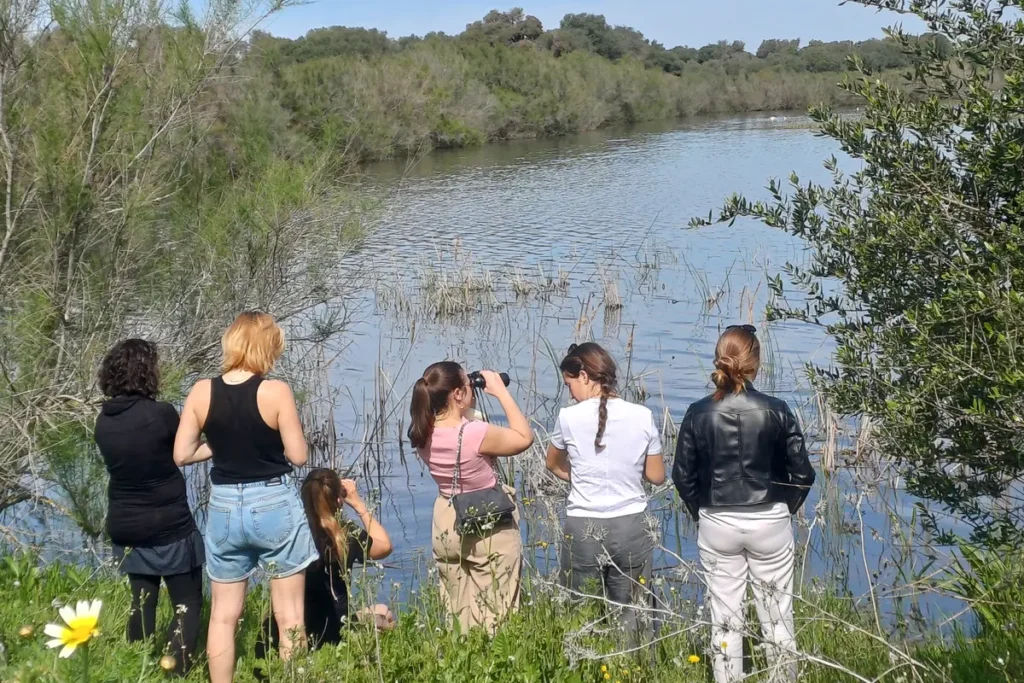
Binoculars for wildlife watching.
Food and drink are not included. There is a break with free time for lunch.
The order of the visits may change depending on the group, the tides or the time of year.
In summer, bring a swimsuit and a towel. The route reaches the beach and there is usually time for a swim.
Comfortable footwear you do not mind getting sandy. Part of the day is a walking route through the gallery forest and part is on dunes.
Sun protection and a hat. The marsh and the dunes have almost no shade.
Bring some water and a snack. In spring, insect repellent is worth having near the water.
Binoculars are provided, but bring a camera with some zoom if you have one: the wildlife keeps its distance.
There is a break with free time for lunch. You can eat at a local bar or restaurant, on which your guide can make recommendations, or bring your own picnic.
Free cancellation up to 24 hours before the activity. You can cancel from the confirmation email you receive when you book.
Ways to visit
Choose how you visit
Everything on this page describes the shared day trip. The same visit is also sold in other formats, each with its own group size, languages and price, and every one of them is booked right here.
Shared day trip
From €94per adult
- GroupRegular group
- LanguagesEN / ES / FR / IT, chosen when you book
The full day exactly as this page describes it, in a regular group, with transport from Seville and the 4x4 route through the restricted areas of the park.
Check datesPrivate group
From €473per group
- GroupYour party only
- LanguagesEnglish or Spanish
The same day for your party alone, priced per group rather than per person, with the pick-up point agreed with you after booking.
The best-rated guide to Seville
First-hand local advice, more than 90 pages in PDF: what to see, where to eat, museums and palaces, day trips, opening hours and prices, and tourist maps of the city. Book any activity with us and it’s yours. Get the guide
 Eduardo BallesterosSeville local and author of the guide
The day trip
Four ecosystems, and a track most people cannot drive
Donana is the largest roadless wilderness left in Western Europe: a mosaic of marsh, pine woods, moving dunes and empty beach where two continents overlap and most of Europe’s migrating birds stop to feed. This day trip crosses it by 4×4, including a restricted area closed to private vehicles.
The marshes and the storks
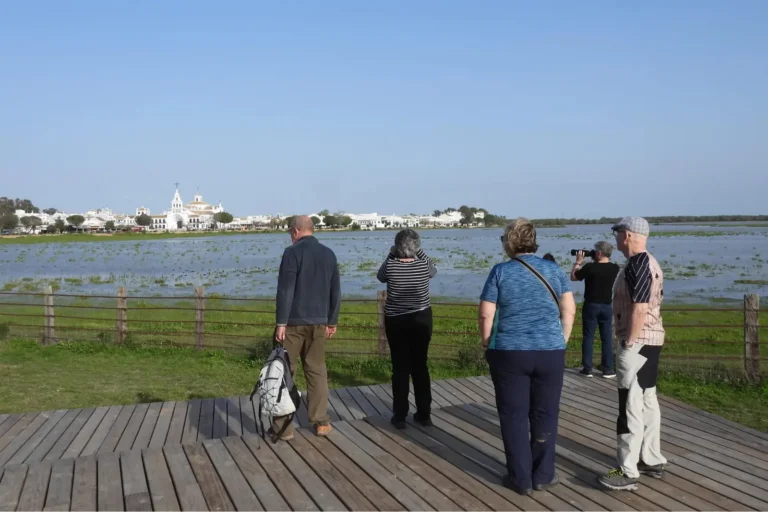
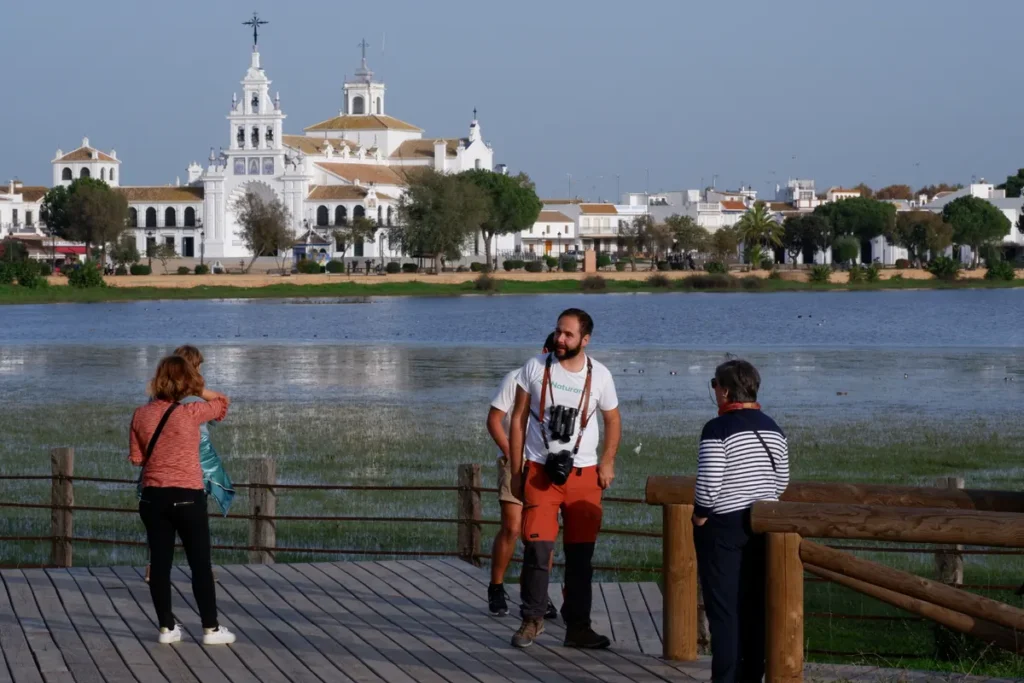
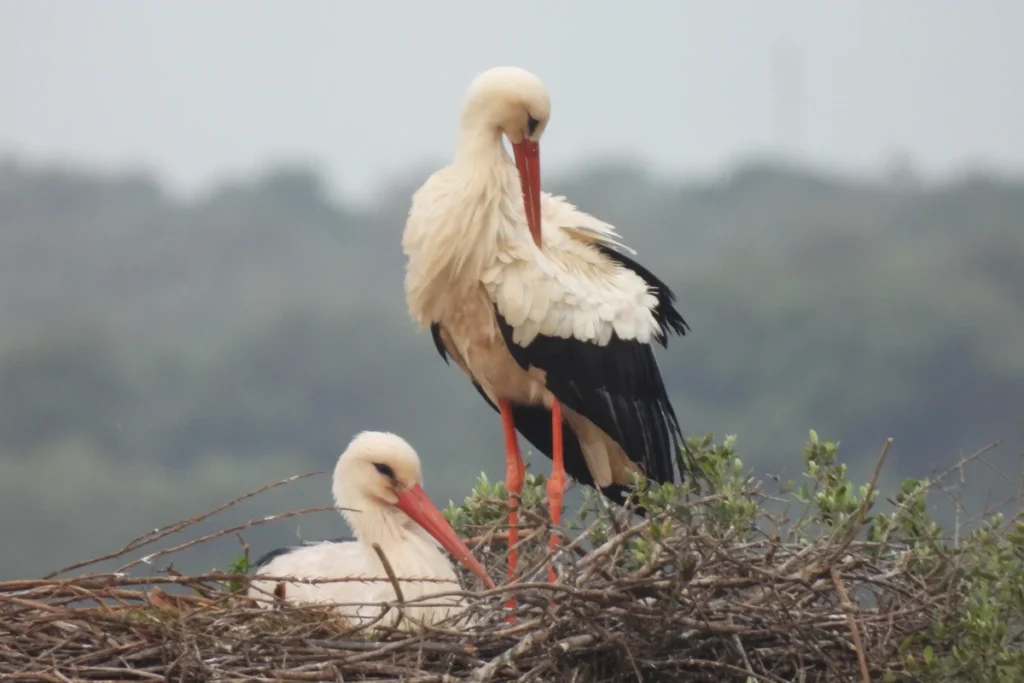
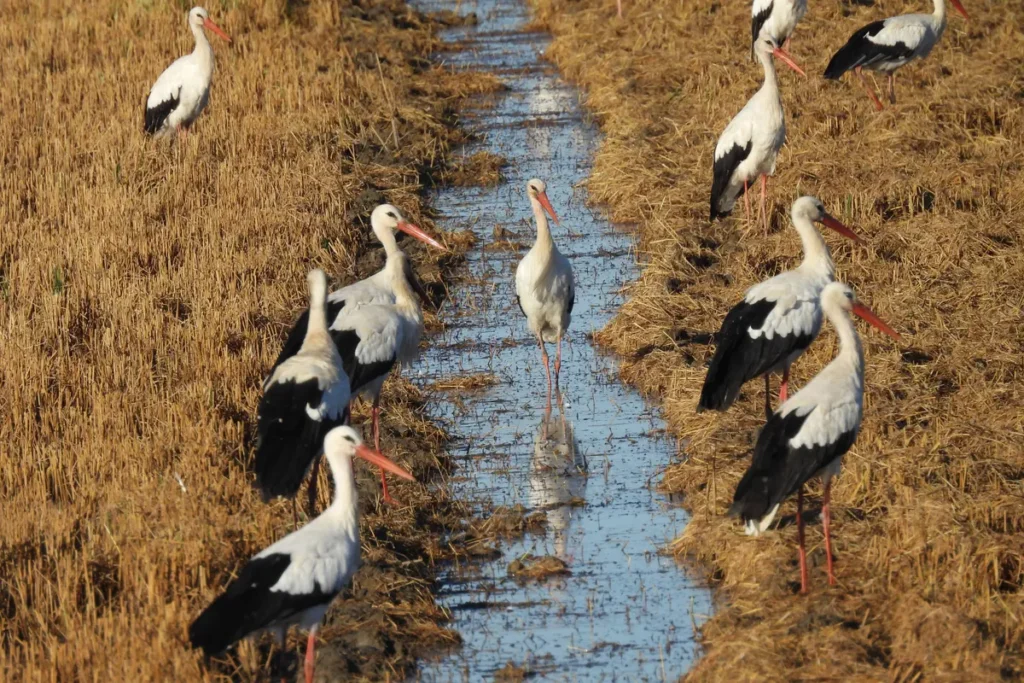
The first stop is on the edge of the Donana marshes near Puebla del Rio, at the Dehesa de Abajo, an old wild olive wood that holds the largest colony of white storks in Europe. The pasture sits just above the water, which makes it an unusually easy place to watch hundreds of birds without disturbing them.
El Rocio
The village of El Rocio has sandy streets instead of paved ones, hitching rails outside the houses and horses moving through it, and it looks much as it did a century ago. At its centre stands the sanctuary of the Virgen del Rocio, the destination of a pilgrimage that draws around a million people every year.
Into the gallery forest
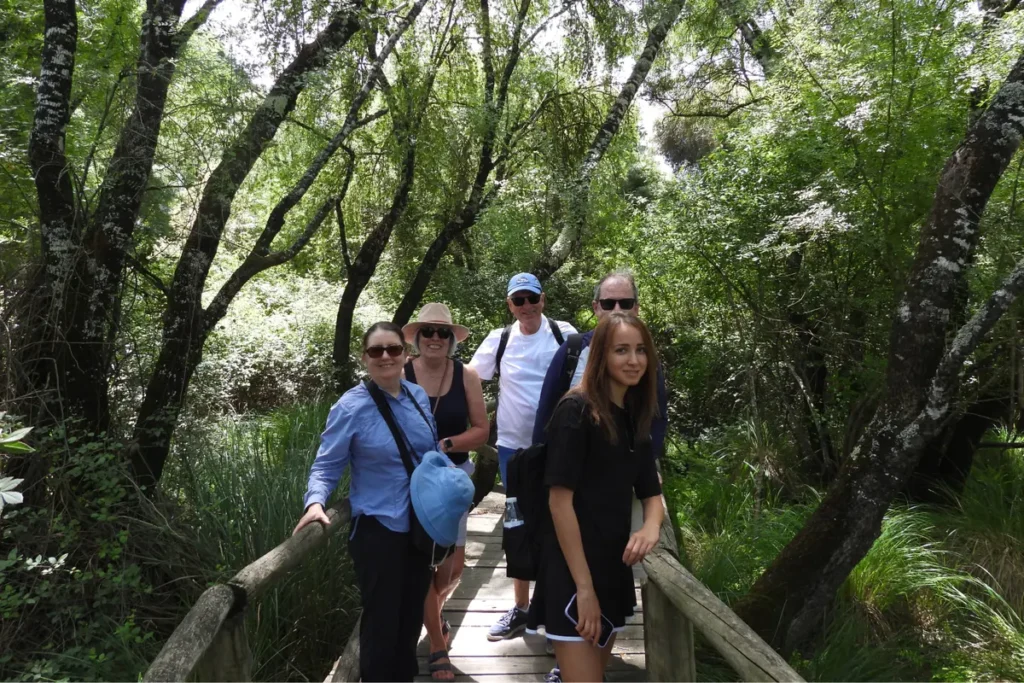
From there the 4x4s head for the Palacio del Acebron, beside the Arroyo de la Rocina, and a different ecosystem again: gallery forest, the wooded corridor that follows the water. There is a circular walk here, reading animal tracks and looking at plants that grow nowhere else.
Dunes, beach and the drive back at dusk
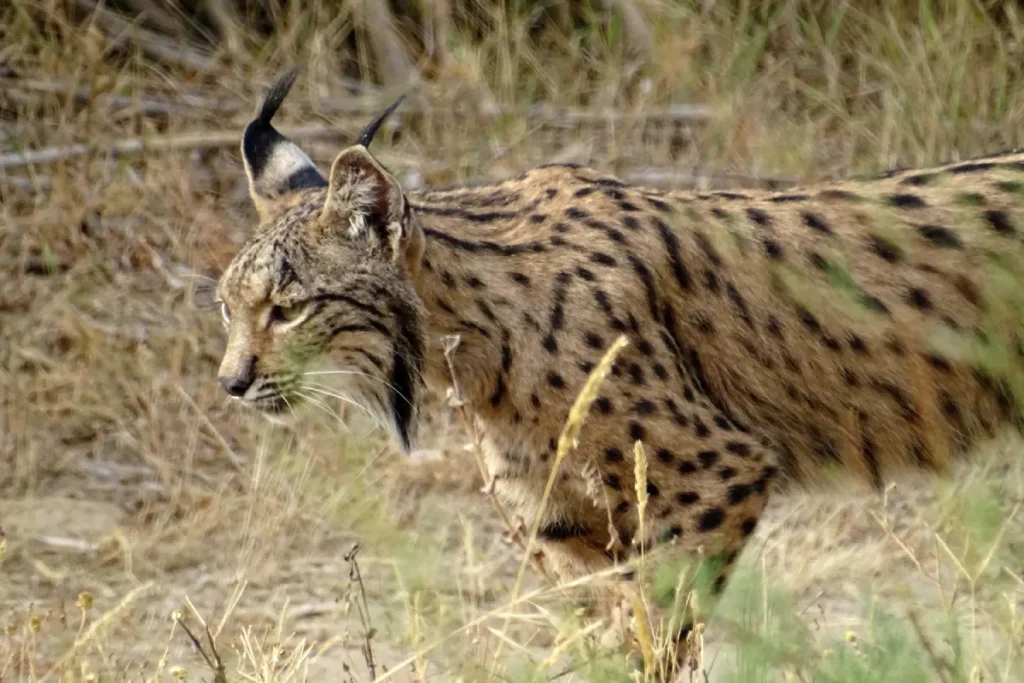
The last ecosystem is the coast, and the beach at Donana is the longest undeveloped one in Spain: no promenade, no buildings, just shifting dunes and sand. The return at dusk goes through the wooded part of the park, which is the best time of day for spotting deer, wild boar and, with a great deal of luck, the lynx.
Important: the order and format of the route may vary depending on the time of year, the weather, road conditions and each town’s local holidays. Your guide will organize the day in whatever way works best for the group.
Your questions answered
Frequently asked questions
Almost certainly not, and nobody can promise it. The lynx is the emblem of the park and the drive back at dusk goes through the woodland where it lives, so it is worth watching. But sightings are rare and the guides treat one as a very good day, not as part of the itinerary.
Birds above all, in large numbers and at close range, which is what the binoculars are for. Red deer, fallow deer and wild boar are common in the wooded areas, particularly at dusk. Beyond that it depends on the season and on luck.
The vehicle is a 4×4 from Seville onwards, not just inside the park. Part of the day is spent driving, part on foot on a circular walk in the gallery forest, and part standing still watching birds.
Most of the National Park is closed to private vehicles, and the tracks inside it can only be used by authorized operators with a permit. That access is included here, and it is the main reason to come with a tour rather than on your own.
Yes, binoculars for wildlife watching are included in the price.
Usually yes, weather permitting, so bring a swimsuit in summer. The beach is undeveloped, which means no lifeguards and no facilities, and the Atlantic here has a current.
Around ten hours. The exact departure time for your date appears in the booking calendar.
Spanish, English, French and Italian. You choose when you book. Usually the guide runs the day in one language, although it is sometimes run in two at once, with the guide alternating between them.
You are picked up at your hotel or accommodation in central Seville, and that is also where the trip ends. After you book, the exact time and pick-up point are confirmed with you by email or telephone. If you are staying outside central Seville, choose C. Rastro 12A as your pick-up point instead and make your own way there.
It depends on the bookings for each date, and groups are usually small. In high season the group is split into two or more subgroups: as a rule, groups are no larger than 30 people. If you would rather not share the vehicle with anyone, you can book it as a private group.
No. There is a break with free time for lunch, at a local bar or restaurant, on which your guide can make recommendations, or you can bring your own picnic.
Less than on our city day trips. There is a circular walk in the gallery forest on level ground, and some walking on sand at the dunes. Most of the distance is covered in the vehicle.
Yes, and there is a reduced rate for children. The animals, the 4×4 and the beach usually make this the easiest of our day trips for younger travelers.
Partly. The driving and the birdwatching stops are manageable, but the forest walk and the dunes are on soft, uneven ground, and a 4×4 is higher to climb into than a coach.
Yes. Cancellation is free up to 24 hours before the activity.
Planning your visit to Donana
Practical questions about the park itself, useful background before you travel.
A 54,000-hectare wetland and dune system where the Guadalquivir meets the Atlantic, protected as a national park since 1969 and listed by UNESCO as a World Heritage Site in 1994. It is the largest area of Western Europe with no roads through it.
Geography. It is the last wetland before the Strait of Gibraltar, so almost everything migrating between Europe and Africa stops here to feed. More than 300 species are recorded, and in winter the marshes hold hundreds of thousands of waterfowl at once.
Only partly. The visitor centres, the boardwalks around La Rocina and the village of El Rocio are open to anyone. The interior of the National Park, where the tracks and the restricted areas are, can only be entered with an authorized operator.
It was the most endangered cat in the world at the start of this century, down to fewer than a hundred animals, almost all of them in Donana and the Sierra de Andujar. Sustained breeding programmes have pulled the total into the low thousands, which is a genuine conservation success, but it remains very hard to see.
El Rocio is a village of sand streets built around a Marian sanctuary, and the romeria is the pilgrimage that converges on it at Pentecost. Brotherhoods walk or ride for days across the marshes with ox-drawn carts. It is one of the largest religious gatherings in Europe, and the village is almost empty the rest of the year.
Late autumn to spring for birds, when the marsh has water and the winter migrants are in. Spring adds flowers and young animals. High summer is hot and much of the marsh dries out, though the beach and the woodland are still worth the trip.
The nearest edge of the park is under an hour from Seville, which is unusually close for a wilderness of this size. El Rocio is about 80 kilometres away.
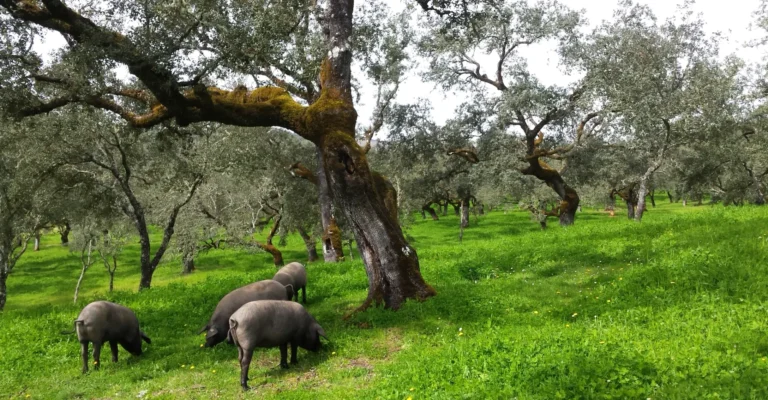
A man-made landscape found across southwest Spain: open pasture with widely spaced holm and cork oaks, grazed by livestock and managed for centuries. It looks like parkland and it is one of the richest habitats in Europe, which is why it sits inside the protected area rather than outside it.